
Tutor LMS Pro 4.1.3 Free Download — Enrollment Checks & Nulled FAQ
Tutor LMS Pro extends a WordPress learning site. We concentrated on enrollment identity, the boundary between two users, and a lesson-completion marker rather than presenting an untested paid course funnel.
Tutor LMS Pro v4.1.3 Free Download
Test record: 2026-10-25 · WordPress 7.1.3; PHP 8.4.27; MySQL 8.4.11; Twenty Twenty-Five 1.5. Isolated Basic Auth/noindex laboratory with synthetic data; external HTTP, real mail and payments blocked.
Enrollment approval is not course completion
Tutor LMS Pro extends a WordPress learning site. We concentrated on enrollment identity, the boundary between two users, and a lesson-completion marker rather than presenting an untested paid course funnel.
The native enrollment record used the status completed for approved access to a free course. Reading that field as proof that the learner finished the course would be a reporting error. The separate lesson timestamp answers a narrower question.
Exactly what we ran
We installed the main ZIP whose version and SHA-256 are recorded at the end of this page. Required companion components are identified in the download inventory. A guarded WP-CLI fixture invoked the installed product’s native methods with synthetic inputs; it did not substitute a mock implementation. The downloadable fixture and result file let a developer inspect the actual calls and their limits.
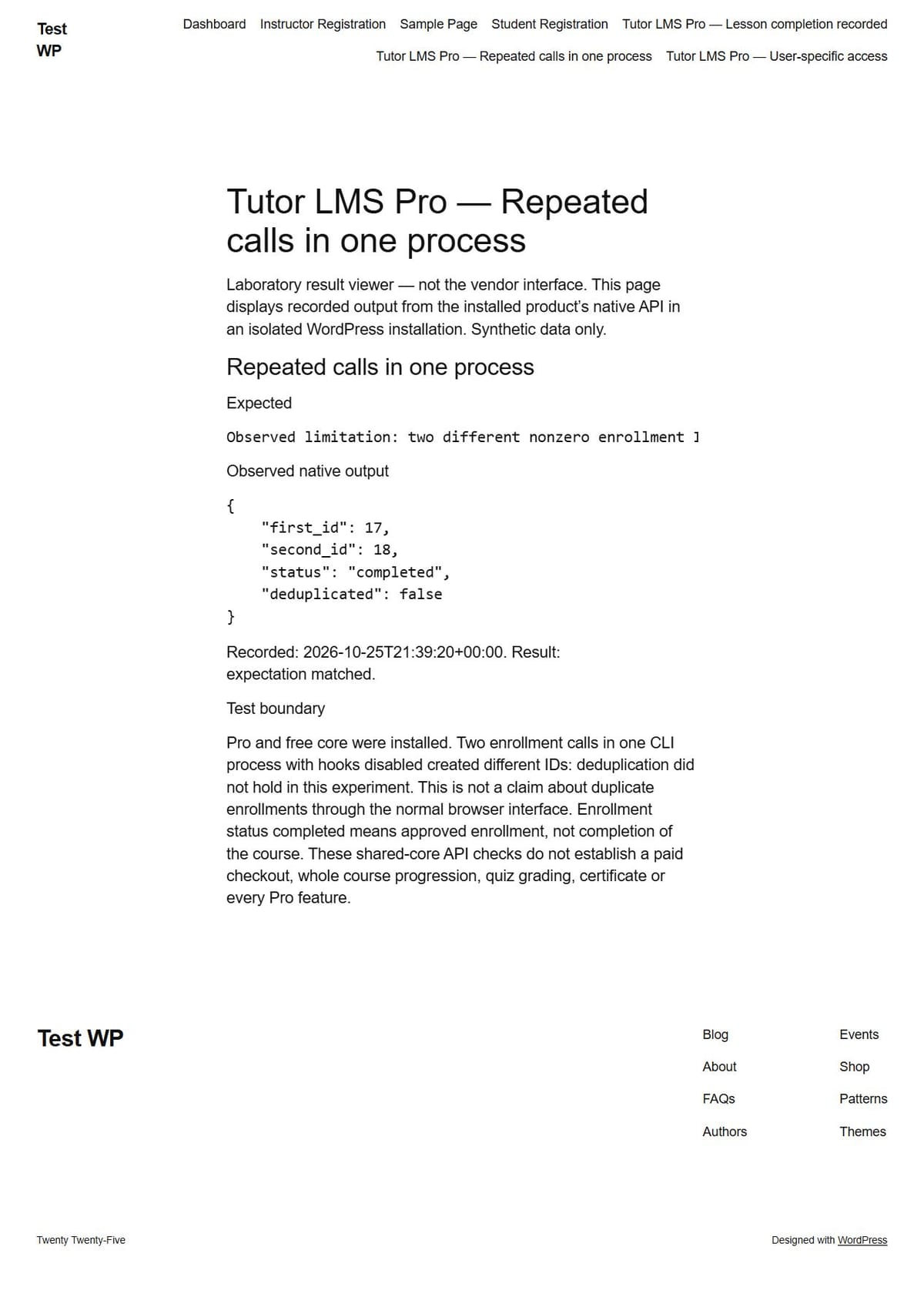
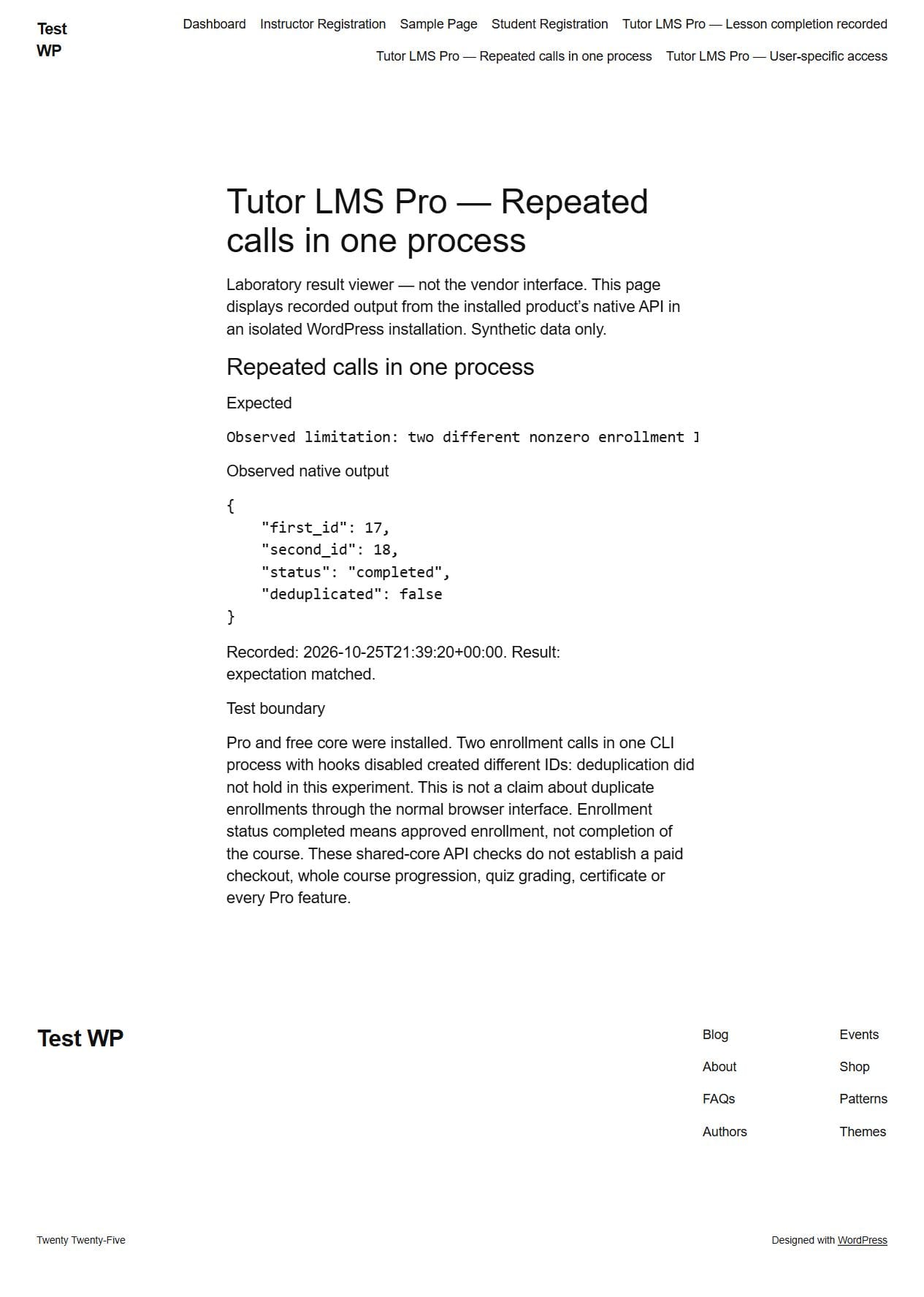
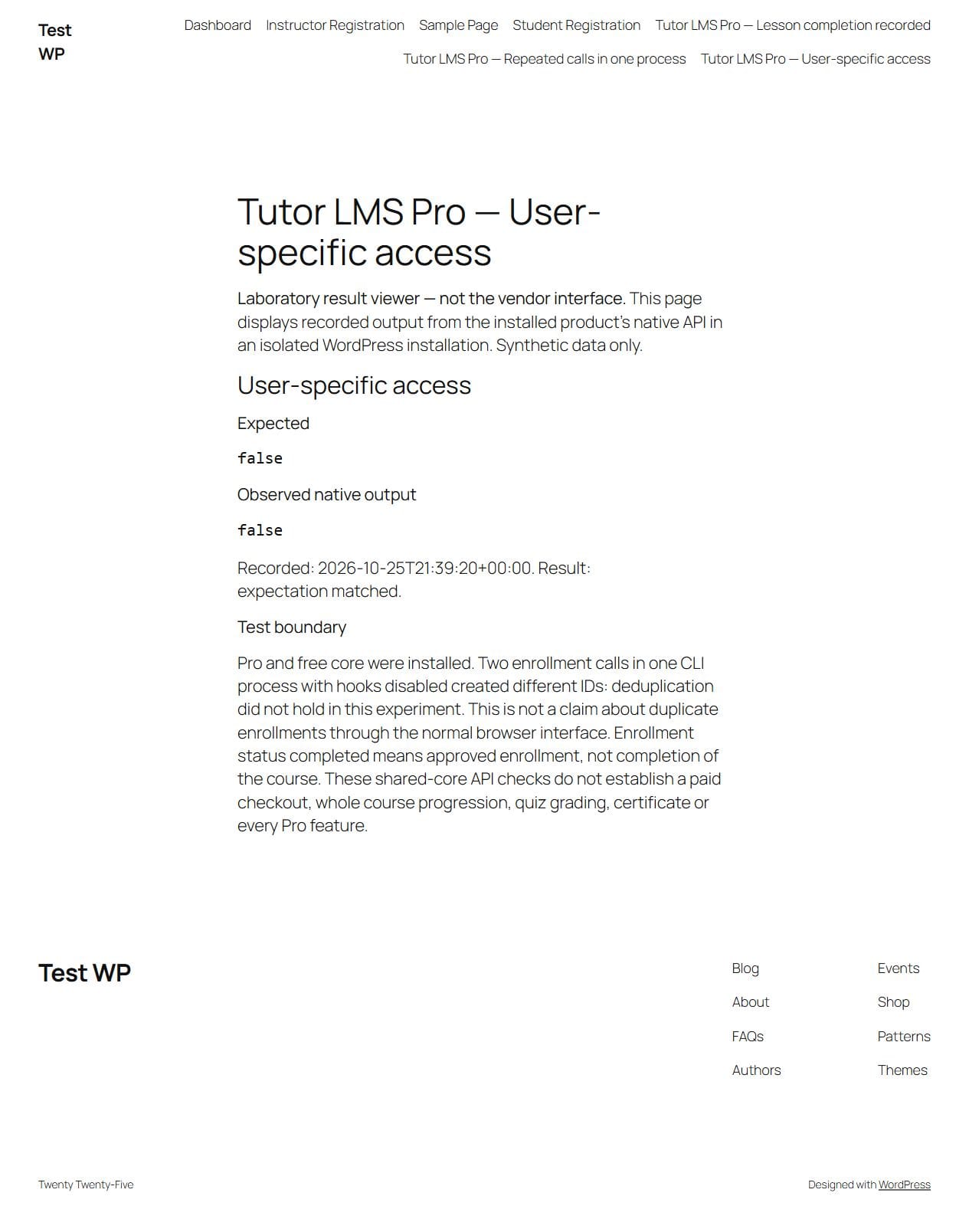
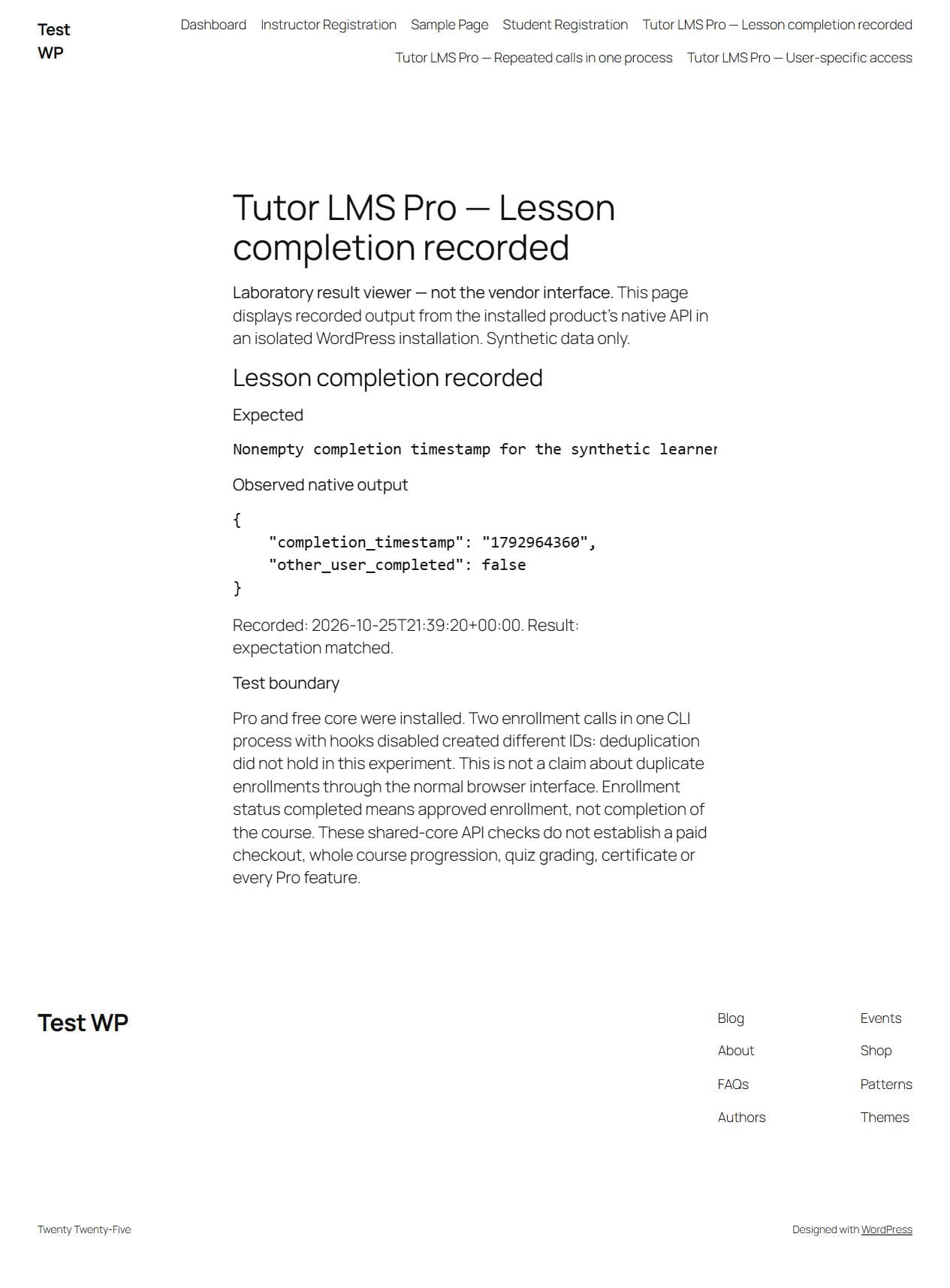
The three screenshots below show our own laboratory result viewer rendering those recorded native outputs. They are real browser screenshots, not generated imagery and not the vendor’s settings interface. A matched expectation means the recorded narrow behavior was reproduced; it does not certify a complete production workflow.
Inputs, expected behavior and observed native output
| Case | Expected or recorded limitation | Observed output |
|---|---|---|
| Repeated calls in one process | Observed limitation: two different nonzero enrollment IDs | {"first_id":17,"second_id":18,"status":"completed","deduplicated":false} |
| User-specific access | false | false |
| Lesson completion recorded | Nonempty completion timestamp for the synthetic learner | {"completion_timestamp":"1792964360","other_user_completed":false} |
Our two hooks-disabled enrollment calls in the same CLI process returned different IDs. The initial deduplication expectation failed. A runtime lookup cache was retained during this experiment, so custom integrations should test separate requests and their normal hooks before relying on repeated calls being harmless. This does not establish a duplicate-enrollment defect in the browser workflow.
Repeated calls in one process
User-specific access
Lesson completion recorded
What these results do and do not establish
Pro and free core were installed. Two enrollment calls in one CLI process with hooks disabled created different IDs: deduplication did not hold in this experiment. This is not a claim about duplicate enrollments through the normal browser interface. Enrollment status completed means approved enrollment, not completion of the course. These shared-core API checks do not establish a paid checkout, whole course progression, quiz grading, certificate or every Pro feature.
Use the recorded versions as the starting point for reproduction. Account services, update access and developer support are separate from possession of a ZIP. A different dependency version, imported design or server configuration can change the result, so rerun the relevant cases before relying on them on a live site.
Repeat the experiment on staging
Install the recorded dependency versions, then read common.php and adapt its explicit staging guards before running the fixture. Keep external HTTP, mail and payments blocked. Use a disposable staging copy; the scripts intentionally create synthetic records.
Original captures and private laboratory snapshots are retained separately from the public fixture. Public result URLs use an example staging origin. The downloadable resources are developer test material, not an installable add-on and not a copy of a customer database.
Version and release-note boundary
The main ZIP header declares 4.1.3. The current download button and package record use that value. We have not independently confirmed a vendor changelog for this exact release, so these observations must not be read as a summary of newly added vendor features.
Nulled, GPL and package questions
“Nulled” usually describes software whose activation or licence checks have been removed or altered; the word alone does not determine whether a particular use is lawful. GPL-covered code can be studied, modified and redistributed subject to its licence conditions, but this does not grant access to a developer’s account, hosted services, updates or support. We discuss the term here to answer a common search question; the download details separately identify the package source and tested version. Any plugin or theme obtained through an unverified third party can contain unwanted changes or malicious code, whether or not it is labelled “nulled”. Before installing it, you can ask ChatGPT or Claude Code to inspect the extracted source for suspicious behaviour without executing it or sharing credentials. Treat that review as an additional check: AI can miss harmful code or flag harmless code, and a clean result is not a security guarantee.
Does downloading this package include the developer’s service account? No account entitlement is established by these tests. Check the developer’s terms for hosted services, updates and support. The inventory describes only the supplied component snapshot; optional companions were not all installed or tested.
Exact download record
Source: GPLHub. Package version 4.1.3. Main ZIP: 7637603 bytes. SHA-256:
9a09d34d07c92bbbf938e755f42027572317192948c42416cb62e342da2f6465
Companion ZIP: 14103984 bytes. SHA-256:
148ae3da49055a3f5488f0f69c1ea8b19874236c1c1349af30f5da72fe82b751
The GPLHub source listing labels this package activated/preactivated. It must not be described as an unchanged vendor ZIP. No account entitlement, vendor byte identity or security certification is established by these bounded tests.
Included add-ons and dependencies (12 archives)
- Tutor LMS 4.1.3 (dependency)
- Tutor Alipay 1.0.0 (addon)
- Tutor Authorize.Net 1.0.5 (addon)
- Tutor Klarna 1.0.1 (addon)
- Tutor LMS Certificate Builder 1.3.2 (addon)
- Tutor Mollie 1.0.0 (addon)
- Tutor Paddle 1.0.4 (addon)
- Tutor Paystack 1.0.0 (addon)
- Tutor Razorpay 1.0.3 (addon)
- Tutor Stripe 1.0.9 (addon)
- Tutor 2Checkout 1.0.1 (addon)
- TutorLMS Attendance 1.1.3 (addon)
Free package downloads
Tutor LMS Pro v4.1.3 DownloadTutor LMS Pro All Addons DownloadDated 26 October 2026 GPLHub companion snapshot, with duplicate and superseded component roots removed. Dependencies and child themes are listed separately. Optional components are inventoried, not all installed or certified compatible. This is not every official add-on ever released. Extract the outer companion archive first, then install only the individual plugin ZIPs you need.