
WP All Import Pro 5.1.0 Download: CSV Update Tests & Nulled FAQ
Five actual WP All Import Pro 5.1.0 checks: first CSV import, repeat identity, selective updates, blank prices and unmatched targets. See real screenshots, synthetic fixtures and separate main/add-on downloads.
WP All Import Pro v5.1.0 Free Download
Test record: 2026-10-16 · WordPress 7.1.3; PHP 8.4.26; MySQL 8.4.11; Twenty Twenty-Five 1.5; supplied WP All Import Pro 5.1.0 + baseline WP Reset. Native packaged CSV importer via WP-CLI, saved post/custom-field/counter assertions and actual browser captures. Three synthetic ordinary posts; private Basic Auth/noindex lab; external HTTP/mail blocked.
What this WP All Import test answers
A recurring CSV import becomes useful when it can find the same records again and change only the fields you intended. We tested WP All Import Pro 5.1.0 with three synthetic WordPress posts, a stable external identifier, a price custom field and a deliberately edited description. The important question was whether a later import would preserve identity and editorial work while still applying selected changes.
The native packaged CSV importer ran through WP-CLI. We then read the saved posts, custom fields and native import counters, checked the full record logs for the unmatched-target probe, and captured the actual WordPress screens. Five assertions passed. This is a small functional test of ordinary posts; it is not a WooCommerce integration or a large-catalog performance benchmark.
| Component | Observed value |
|---|---|
| Tested package | WP All Import Pro 5.1.0 supplied through GPLHub |
| WordPress / PHP | 7.1.3 / 8.4.26 |
| Database / theme | MySQL 8.4.11 / Twenty Twenty-Five 1.5 |
| Other regular active plugin | Baseline WP Reset |
| Boundary | Private authenticated lab; noindex response headers; external HTTP and email blocked |
| Data | Three synthetic ordinary posts and custom price fields |
The result report was finalized at 2026-10-16T11:02:45+00:00. The isolated lab was preserved after the browser captures. No customer records or production posts were used.
First import and repeat import: the same three records
The baseline CSV contained EXT-A, EXT-B and EXT-C, each with a title, description and price. The saved import used catalog-fixture-{external_id[1]} as its unique key. The first run created three posts with IDs 5, 6 and 7. Repeating the same file through the same saved import kept those IDs and created zero new posts.
The repeat-run counters were zero created, three updated and zero skipped. That distinction matters: our test proves stable matching and no duplicate posts for this fixture. It does not prove that unchanged rows were skipped to save processing time.
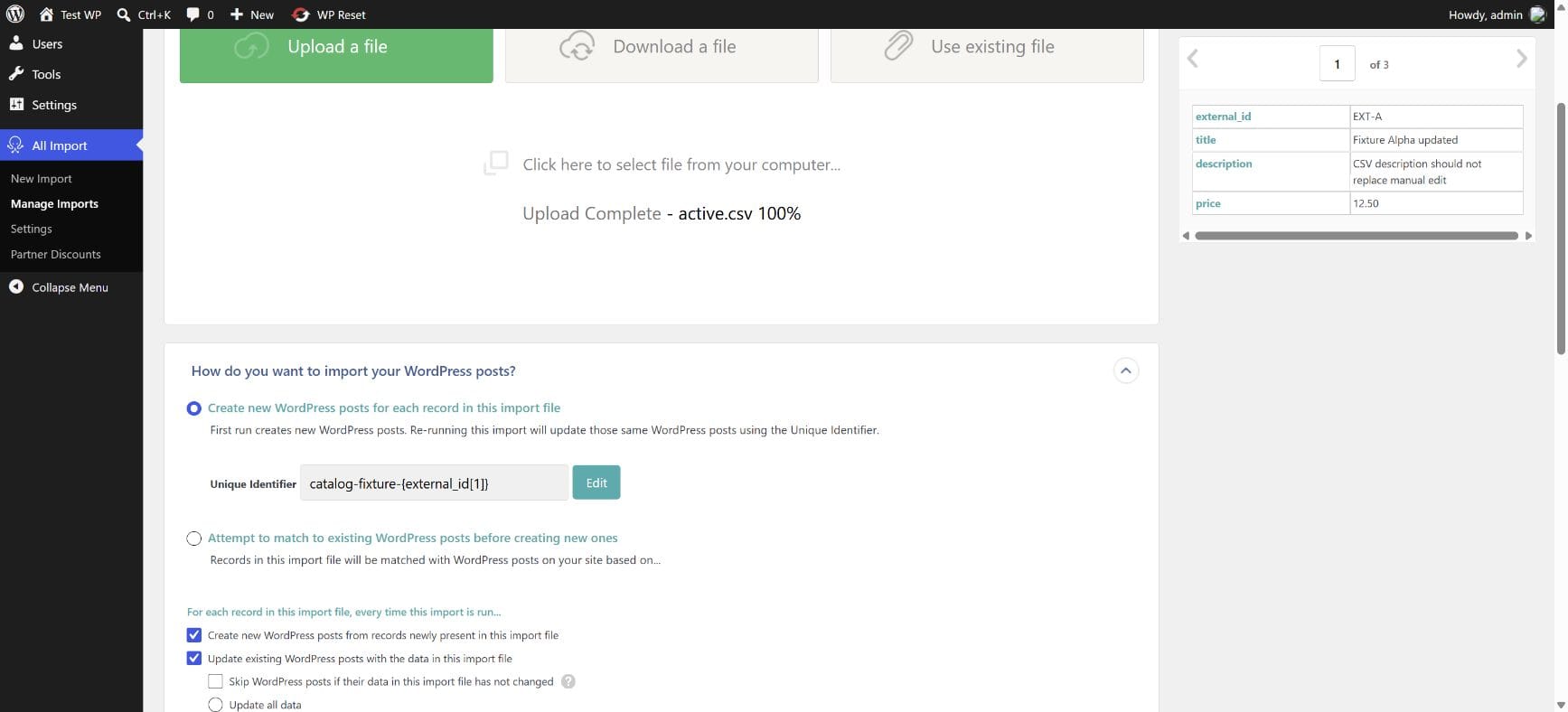
The official identifier guide explains that the key should remain stable for each record and that matching belongs to the saved import process. Creating another import with an identical key does not automatically inherit the first job’s record history. Use a source ID that survives title, price and description changes.
Update title and price while retaining a manual description
Before the next run, we manually replaced EXT-A’s post content with MANUAL_DESCRIPTION_MUST_SURVIVE. The replacement CSV deliberately supplied a different description. We configured the saved job to update Title and only the _catalog_price custom field, with Content updates disabled. The later import changed EXT-A’s title and price to Fixture Alpha updated and 12.50, retained post ID 5, and left the manual description intact.
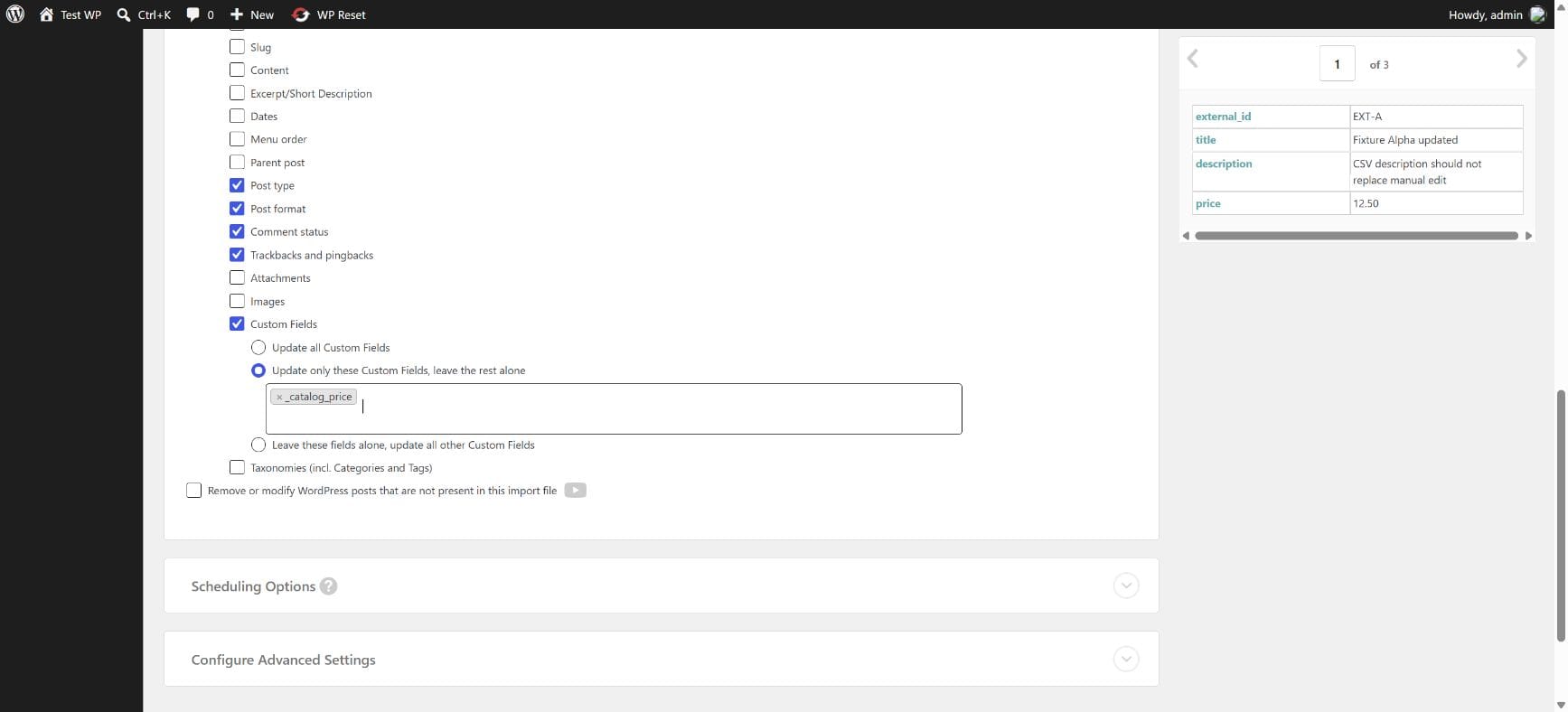
This behavior fits the vendor’s field-selection documentation: choose the fields that may be overwritten and leave other fields outside the update. It is a configuration choice, not automatic protection for everything an editor has changed.
An empty selected price cell cleared the stored value
EXT-B began with price 20.00. Its replacement CSV row had an empty price cell and an empty description cell. Because price was selected for update, the saved price became an empty value. Because Content was excluded, Imported beta description remained. A blank cell and an excluded field are different instructions in this setup.
| External ID / post ID | Title | Description | Price |
|---|---|---|---|
| EXT-A / 5 | Fixture Alpha updated | MANUAL_DESCRIPTION_MUST_SURVIVE | 12.50 |
| EXT-B / 6 | Fixture Beta updated | Imported beta description | Empty value |
| EXT-C / 7 | Fixture Gamma updated | Imported gamma description | 30.00 |
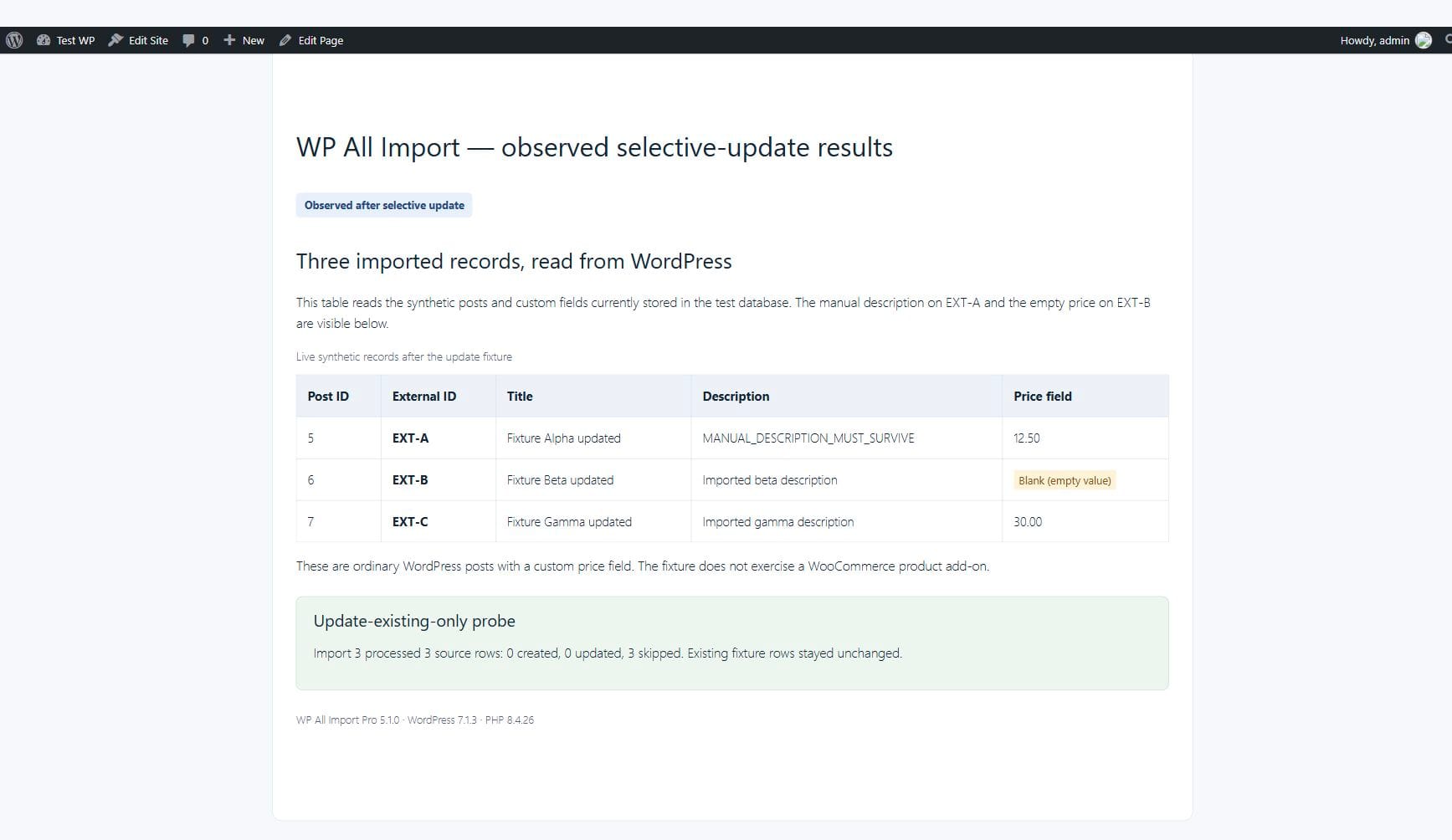
If a supplier uses blank cells to mean “keep the old price,” define and test that policy before importing. Our fixture intentionally expected the selected blank price to clear the field; it did not test a keep-existing-on-blank filter.
Unmatched target IDs: three rows processed, three skipped
A separate update-existing-only probe used post-ID matching and disabled creation of new records. Its CSV contained a negative target, a very large nonexistent target and a nonnumeric target. The full import log contained three record sections. Each reported no matching post, then skipped the row because creating new posts was disabled. The final native counters were zero created, zero updated and three skipped, with count three; processing, executing and triggered flags were zero.
The original three fixture rows stayed unchanged. This establishes the tested no-match behavior with creation disabled. It does not establish a general numeric-ID validator or automatic rejection of every duplicate or blank external identifier in a create-new import.
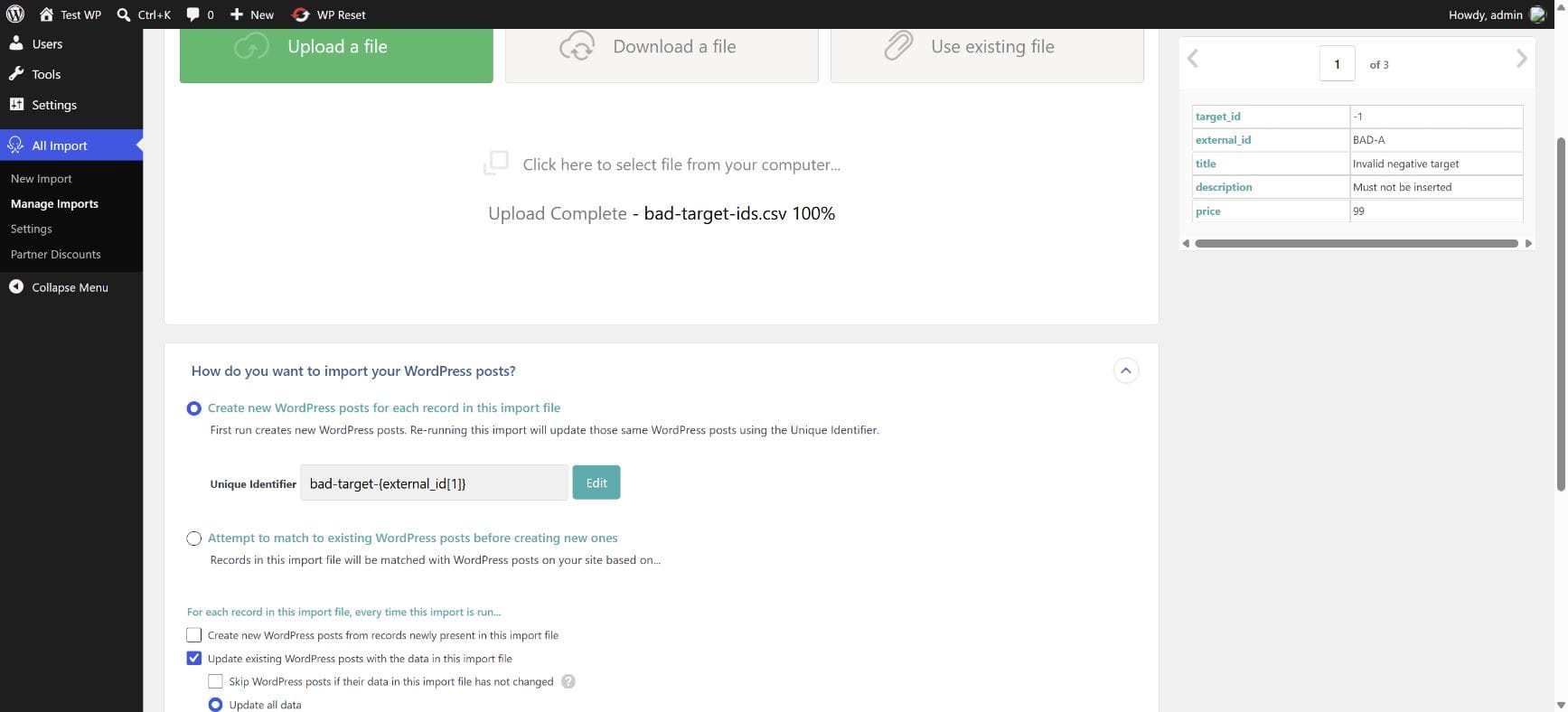
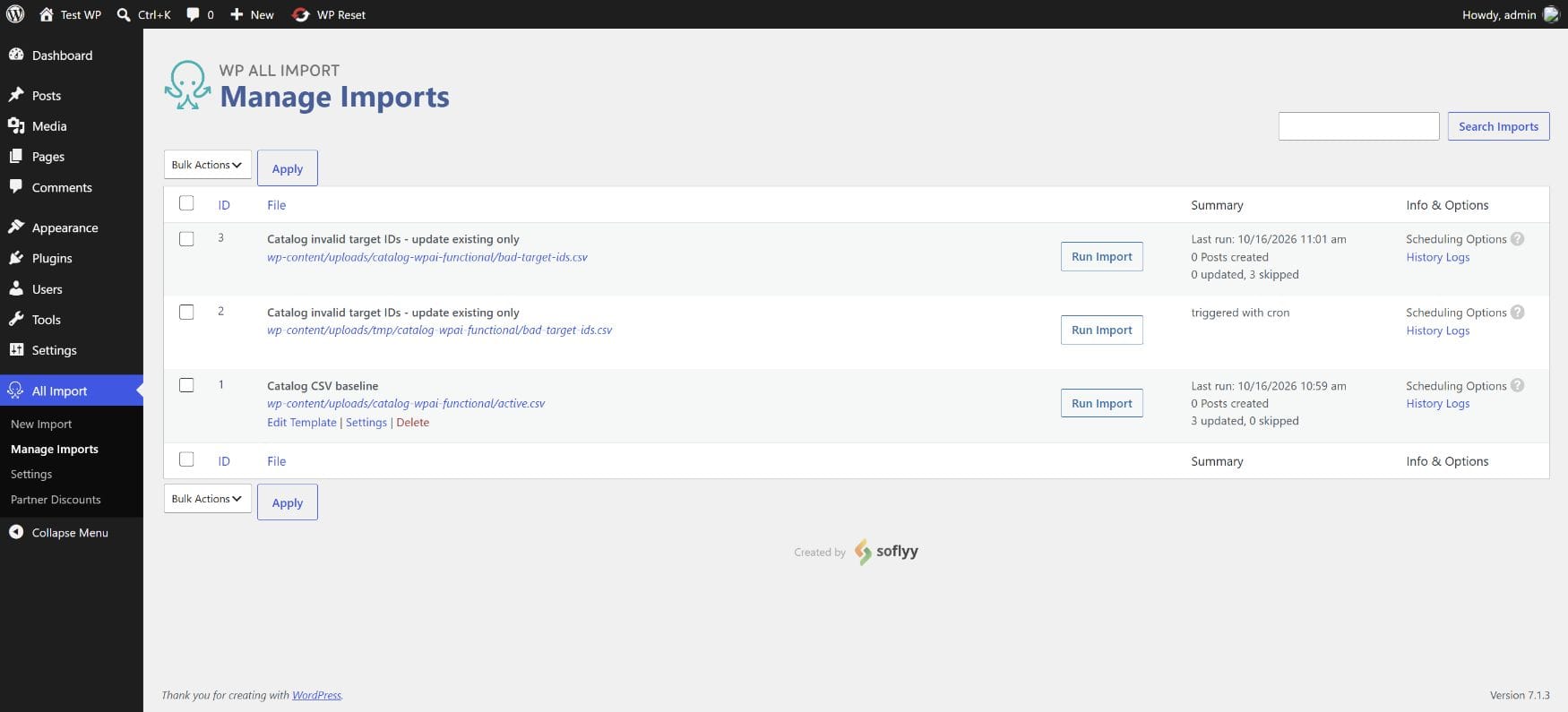
One practical issue surfaced during preparation: a CSV path under a temporary directory did not reach the intended source-processing path. A zero-created/zero-updated summary alone would have been insufficient proof. The final run used persistent uploads storage, and its pass condition required three actual skips, three source records and unchanged fixture rows.
Reproduce the five checks on a disposable installation
- Start with a backup and a disposable WordPress installation using the tested 5.1.0 package. Map baseline.csv title, description and the supplied custom fields; use the stable external_id key.
- Run the baseline file, record the three resulting IDs, then rerun the same saved job and compare identities and creation counters.
- Edit EXT-A’s description manually. Select only Title and _catalog_price for update, disable Content updates, and run selective-update.csv through the same job.
- Check the stored values, including EXT-B’s empty price and retained description.
- For the separate unmatched-target probe, match the target_id field to post IDs and disable new-record creation. Confirm the large target does not exist in your disposable site. Require three actual record logs and three skips, not merely zero creations.
- Synthetic CSV fixture archive
- Manual reproduction specification — not a native template import
- Public test results JSON
The fixture archive contains three small CSVs and a JSON reproduction specification. It is not a plugin ZIP or a one-click native import template. IDs in the report belong to this one lab run and will differ on another installation.
Package contents, version limits and installation
The main download is WP All Import Pro 5.1.0. The separate All Addons archive is the eight-item GPLHub package snapshot collected on 16 October 2026. It contains individual add-on ZIPs and an inventory; extract the outer archive, then install only the add-ons your workflow needs. The outer bundle is not directly installable as one WordPress plugin. None of those integrations is established as working by this ordinary-post test.
The eight-item inventory includes six import-side add-ons and two WP All Export add-ons. The export add-ons require their separate WP All Export base plugin; installing WP All Import alone does not provide that dependency. The included JetEngine add-on is labelled 1.0.1-beta-1.2. Read those names and versions before selecting integrations.
The supplied main package came through GPLHub. We do not have a trusted vendor ZIP baseline for a byte comparison, so its modification status is unknown and vendor byte identity is not asserted. The package record and hashes identify the particular files offered here; the tests establish the scoped observations above.
The official changelog lists WordPress 5.0 and PHP 7.4 as minimums for 5.1.0, updated dependency libraries, and an experimental Automatic Setup feature that is off by default. Automatic Setup was not tested. The vendor changelog checked on 16 October already lists 6.0.1, so 5.1.0 is not presented as the newest release. It also records a licence requirement introduced in 6.0.0 for imports, including scheduled runs, with a grace period for lapsed licences. These 5.1.0 results must not be extrapolated to 6.x activation or service behavior.
- Install the main ZIP on staging first and activate it before the required integration add-ons.
- Choose a stable source identifier and explicitly select overwrite fields before updating valuable records.
- Compare real stored values and logs on a small representative sample before scheduling or scaling an import.
- If you only need a one-time transfer between WordPress installations, consider whether the built-in WordPress export/import workflow is sufficient.
What remains untested
We did not test WooCommerce products or variations, remote image downloads, scheduled cron runs, external account services, Automatic Setup, very large files, multilingual integrations or every bundled add-on. Three synthetic rows cannot establish throughput or compatibility with every theme and plugin. This run also does not claim that all package changes were audited or that an archive is guaranteed safe.
WP All Import Pro download and Nulled FAQ
“Nulled” usually describes software whose activation or licence checks have been removed or altered; the word alone does not determine whether a particular use is lawful. GPL-covered code can be studied, modified and redistributed subject to its licence conditions, but this does not grant access to a developer’s account, hosted services, updates or support. We discuss the term here to answer a common search question; the download details separately identify the package source and tested version. Any plugin or theme obtained through an unverified third party can contain unwanted changes or malicious code, whether or not it is labelled “nulled”. Before installing it, you can ask ChatGPT or Claude Code to inspect the extracted source for suspicious behaviour without executing it or sharing credentials. Treat that review as an additional check: AI can miss harmful code or flag harmless code, and a clean result is not a security guarantee.
Will repeating a CSV always avoid duplicates? Our same-job fixture retained its three IDs with a stable external_id key. A different job, changed key or ambiguous source identifiers need their own matching checks.
Does an empty price preserve the old price? Not in this tested selection: _catalog_price was selected for update, so the blank cell cleared it. The description remained because Content updates were disabled.
Were WooCommerce imports or scheduling tested? No. The five passing checks used ordinary WordPress posts and a custom price field; installation of an integration is not proof of its import behavior.
Can I install the All Addons archive directly? Extract it first and install the required individual plugin ZIPs. Read the inventory and dependency requirements for your selected integration.
Exact download record
Source: GPLHub. Package version 5.1.0. Main ZIP: 4370010 bytes. SHA-256:
8c38753da981293432c5ff2fff4124ccb9cf5c7f0a90e964f1fbb222c09772bb
All Addons ZIP: 998525 bytes. SHA-256:
d4bbb738bf302268ed19fe993dd6613dc5968536c58b6768f23945c21839d83a
Supplied GPLHub package has no trusted vendor ZIP baseline for a byte comparison, so modification status is unknown. Functional tests cover ordinary-post CSV imports only; add-ons, scheduled runs and external account services were not tested.
Included add-ons and dependencies (8 archives)
- WP All Export - ACF Export Add-On Pro 2.0.0 (addon)
- WP All Export - WooCommerce Export Add-On Pro 1.0.11 (addon)
- WP All Import - ACF Add-On Pro 4.0.2 (addon)
- WP All Import - Gravity Forms Add-On 1.0.2 (addon)
- WP All Import - JetEngine Add-On 1.0.1-beta-1.2 (addon)
- WP All Import - Link Cloaking Add-on 1.1.5 (addon)
- WP All Import - User Import Add-On Pro 2.0.0 (addon)
- WP All Import - WooCommerce Import Add-On Pro 4.0.7 (addon)
Free package downloads
WP All Import Pro v5.1.0 DownloadWP All Import Pro All Addons DownloadAll addons included in the GPLHub package on 2026-10-16, with duplicate and superseded copies removed. This is a dated GPLHub snapshot, not a claim to include every official addon ever released. Extract the outer All Addons archive first, then install only the individual plugin ZIPs you need.